
EP20: But Why is Your Employee Annoying You? 2 Simple Steps to Find the Why and Take Action

DTD Episode 20 Show Notes

But WHY is Your Employee Annoying You?
2 Simple Steps to Find the Why and Take Action

Click to download the show notes for the Defeat the Drama Podcast Episode 20
annoying_employeesToo often I run across leaders who say an employee (or two or three) is annoying them but they haven’t stopped to figure out why.

I once had a client share that she was doing all that she could to avoid an employee that she just could not stand.

“What is she doing that’s so annoying?”, I asked.

Upon further investigation I learned that the employee was a whiner. She complained about her life, her work, and her co-workers constantly.

I quickly pointed out that ignoring her was problematic on many levels. Here’s what I shared

1. She was probably annoying the rest of the team as well and creating lots of drama. By choosing to ignore rather than address her whining the behavior would continue unchecked. Fellow employees, not empowered to actually do anything about her or for her may end up leaving out of frustration. At a minimum she was wreaking havoc and frustrating her team. You can’t have such energy busting behavior at work!

2. Think of all the wasted time! Every minute she is using during paid time to complain without problem solving is productivity time lost. And you are not just losing the time of the annoying employee. You are also losing the time of the co-worker she’s talking to. And, if anyone is complaining ABOUT her after the fact, there’s some more productivity time down the tubes!

3. Think of all the wasted money! Consider the hourly rates of all of the people who have engaged in complaining with her or about her for 5, 10, 15 minutes or more. Add up the time and multiply by the pay per minute. Staggering, I promise you!

4. What if there are some nuggets of value to some of her complaints? It’s the boy who cried wolf syndrome. She complains non-stop and now no one actually listens to a word she says. There may be times when there is valuable insight mixed in with all of the garbage coming out. You are missing the opportunity to gain anything from her perspective. She has become a silent and yet loud force in your organization. If she focused on communicating just what was most important and relevant you might gain value.

5. She doesn’t realize it………Probably. People politely listening and a boss who listens or avoids all reinforce her belief that it’s okay to air all of your grievances constantly at work. You’ve all become the shoulder she can cry on or the listening ear. It might be her way of getting attention or feeling important. It’s all misguided. I have also seen more than once that, believe it or not, people who talk a lot often do so because they feel unheard. It becomes a self-fulfilling prophecy. I’m not heard. Let me speak more or speak louder. And then they are heard even less. She doesn’t realize that she’s minimizing her ability to be successful and driving everyone crazy. She is also diminishing her ability to have real and valuable impact.

So, my wonderful listening leaders, please, please please, figure out exactly why that employee is annoying you. Then create an action plan for them and communicate it. Give that annoying employee, your team and your business a fighting chance!

Your annoying employee may not be a complainer. Perhaps your annoyance is lacking the right skills to do the job well, or is too hyper or too bitter. Maybe he makes too many mistakes or she snaps her gum or has an issue with body odor.

Choosing to ignore or avoid is a decision to allow or maybe even encourage the annoyance. I encourage you to get clear, create a plan and take action instead.

Here are the steps to take to get in action. Either start with the annoying employees or just go for it and analyze your entire team. It’s time to diagnose why and create a plan.

In a simple Word Document create a column to document specifically what the issue is. Then determine whether the employee issues are an attitude or aptitude issue. Are they both willing and able to do the job?

If it’s an attitude issue, there’s really no process other than to document and then communicate the new expectation. If it is a complaining problem I recommend a conversation that will help the annoyer gain insight about what they are doing and the impact it is having on themselves, the team and the business. Be empathetic rather than overbearing. They may have the best intentions with the wrong execution. Help them hone and redirect some succinct communication efforts with a new emphasis on creating solutions along with identifying issues.

If it’s an aptitude issue, you have to get specific. Which knowledge, skills or abilities are they missing? Is there a plan that can get them to perform the way they must? Should they shadow a co-worker or take an online class? Or is the investment doable or too much?
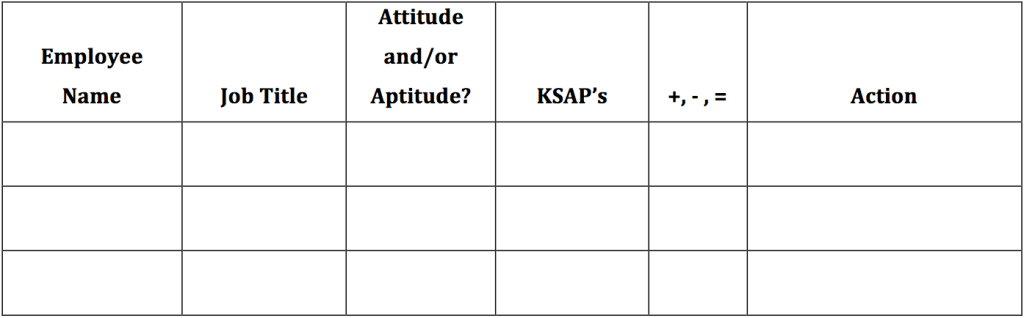
attitude_aptitude_chart

Get Clear with this simple form. Create a plan, communicate it and support them in taking the required steps.

If you enjoyed, I would really appreciate a review on iTunes and Stitcher

EP19: Learn How Leaders Create A Business Culture

DTD Episode 19 Show Notes
Learn How Leaders Create a Business Culture
Lessons from Roger Connors and
“The Oz Principle” 

Click to download the show notes for the Defeat the Drama Podcast Episode 19

experienceIn the book, The Oz Principle: Getting Results through Individual and Organizational Accountability authors Craig Hickman, Tom Smith, and Roger Connors write brilliantly about the leader’s unique role in creating a culture. By your title and position you are the most powerful force.

The authors illustrate in a very simple but powerful fashion how a culture is created.

Leaders create:

  • Experiences
  • Which create beliefs among your employees
  • These beliefs drive actions
  • And actions create business results, either desirable or undesirable. Here’s a quick example to illustrate the phenomenon.

An employee raises her hand in a team meeting and says she has an idea that will help the company save $500 per month. Her leader’s response to this initiative will create a belief in her mind and in those of the other employees in attendance at the meeting.

If the leader responds with excitement and says, “That’s great news! Let’s implement that right away! Thank you! If anyone else has similar ideas please share them!” the experience will be positive and generate a belief that it is good to be innovative and take initiative. Saving money is valued. This belief will drive actions that are consistent. The result will be a team that seeks out ways to save money and take initiative.

If, on the other hand, the leader responds with anger and says, “Why are you wasting your time on things like that? That is not your responsibility. You need to focus on your job.” The belief generated in this scenario is that taking initiative is not valued and can get you in trouble. As a result, each team member will focus only on his or her own job. When they see quality issues or problems that affect customer service or profitability, they will keep their heads down and their mouths shut. And you can figure out how this impacts the organization.

You see, as a leader, you are creating experiences for your employees throughout each day, moment to moment, that generate beliefs. Are you intentional about the experiences you are providing? Are the experiences aligned with the stated mission and vision of the organization? Will they generate the results you desire for your business?

What you choose to focus on, ignore, reward, tolerate, celebrate, express anger or frustration over, all send messages to your team about what you value and about what defines success in your organization. And each of these experiences ultimately drive results.

Your team will take action based on the beliefs they hold. The resulting culture either will support you in your efforts or will stand in the way of progress.

If your actions throughout the day are not consistent with the message you give in your annual rah-rah speech to the team, the daily actions win every time.

So, pay close attention to the experiences you are creating for your team throughout each day. Work to make them align with the kind of culture you need to support your mission.

As illustrated in the tale of two banks in Episode one of this podcast, a culture can make or break you. It goes beyond having the right people.

Let’s look at some other real life examples of how drama can be generated if a culture is not aligned with your business objectives. Even when you’ve hired a person with the right skills and personality, employees will transform to fit the norm of a team. I have seen similar situations over and over as I begin my work with clients:

  • Example #1: A new employee is hired for her high energy and up-beat, positive attitude. Her leaders feels encouraged that she is exactly what his business needs to turn things around. The negativity will be a thing of the past once this little ray of sunshine hits the door.Then, three weeks in she is acting exactly like the rest of the team. What happened?
  • Cause: Her team oriented her to “Here’s how things work around here.” It is human nature to want to fit in. She was thrown to the wolves and it was sink or swim time.
  • Diagnosis: You cannot expect a new person in your business to bear the responsibility of transforming an entire culture, especially if you expect that transformation to happen spontaneously. The expectation had not even been communicated to this employee. She was carrying the burden of her leader’s hope without knowing. She was also lacking the power of communicated leader support that is absolutely required to enact change in a culture.

Leaders, you are most able to enact change. You can certainly enlist the support of members of your team but it must be done overtly and with a promise to support them as they do battle on your behalf.

  • Example #2: A new employee is hired to do billing for a large company. She has a great background and comes highly recommended. She works there for 1 1⁄2 years then goes out on a stress leave. Everyone is shocked. Fellow employees take over only to find stacks and stacks of unprocessed paperwork representing tens of thousands of dollars.
  • Cause: When she first started there was no training to orient her to the specifics of the new organization. She would ask questions but was always met with anger. She was treated as if she were stupid. She had a really good work ethic and wanted to do a good job but she really needed the paycheck and her ego couldn’t take all of the criticism. She had been living with severe stress over the mounting backlog of paperwork and did not know what to do.
  • Diagnosis: The culture did not support training or open communication. Team members in this situation were actually hiding issues all over the place trying to avoid the wrath. The culture was so negative that the stress of doing less than standard work was easier to take than the stress of enduring the treatment for owning up to a mistake. Most of the energy was spent on “duck and cover” or “the blame game” rather than on fixing problems or creating excellent customer service.Now, I am not endorsing the behavior in either scenario. Employees should still always do what is right. However, I understand the behavior. Even the best, most well-intentioned people can go into survival mode and act in ways that they would not ordinarily.

A leader has the power to step in and assure that appropriate training is available. Employees cannot.

When you add people, you are doing it to add more heads, arms, and legs into the arsenal. Ideally, these other heads, arms, and legs will be a coordinated extension of you as leader. If your culture is breeding drama, your team is probably not a coordinated extension of you…You can have all the right people with all the right attitudes, but if the work environment is poor, the team performance will be poor. Bottom line.

I recently visited a store in the mall called, “Buckle.” You may have shopped there yourself. The leaders in that organization understand creating a great culture! Their employees were fueled with passion for denim and the coordinating items in that store. You could feel the intentional focus on fun. They know their products, which will work best for your body type, they suggest coordinating items; and even get shoes for the outfit so you could check the hem length. Multiple people made suggestions. They helped each other, and they spoke excitedly to one another about new items they had just gotten in.

Making that happen requires intentional focus. Their hiring and training processes as well as their reward systems and leadership style, all must support that culture. This kind of culture is never an accident.

What kind of culture are you and your leadership team generating? What are you doing to foster more drama and less productivity? What must you change going forward?

To be a great leader you must have vision, integrity, and tenacity. And you, my friend, must be a great leader! Whether you’re in a small business or a large organization, your team is looking to you as a guide. You must have a plan and a purpose.

If you enjoyed, I would really appreciate a review on iTunes and Stitcher

EP18: Find Focus Time for Success

DTD Episode 18 Show Notes

Find Focus Time for Success 

Click to download the show notes for the Defeat the Drama Podcast Episode 18

timethinkWhen I’m working towards a goal and it feels like I might not achieve it, or perhaps things aren’t going as quickly as I’d like, I tend to just get moving. There are a host of activities I can engage in to try to MAKE my goal happen.

I must admit, it’s happened from time to time during the launch of this podcast. It can be very nerve wracking putting yourself out to the scrutiny of the world. I’ve long had a desire to help more people remove the drama that steals focus in their businesses. I feel a push to get my information to as many leaders and entrepreneurs as possible. I can begin to feel anxious and then get caught up in looking at stats or comparing myself to others, none of which helps me meet my objective.

If only our success could be directly proportional to the velocity of our actions, or could somehow guarantee our achievements.

Busyness does not equal effective and activity isn’t an immediate path to success. If our full motivation is action we may lose much of our focus. Because, often in our race to get in action we forget to just be, consider and contemplate. We lose the opportunity to generate creative, focused action.

We live in a world of do, do, do so we sometimes get caught in the delusion that doing creates success.

In our businesses even the simplest challenges can seem daunting as we get caught on the hamster wheel of doing to get.

Our to do lists get out of control as we write, type and capture actions on paper, task lists and sticky notes.

We focus on getting things checked off over what’s the best use of time. We forget to prioritize and instead accomplish. What’s the easiest? What’s the quickest?

I’ve coached my clients through many situations where the real response was not to do but to stop!

As a leader you need time to sit, think and contemplate on what was, what’s next and which specific actions put you on the path to your destination.

I recommend taking time out at least once a week to think about your business; the work on your business not in it concept. Call it what you’d like, Starbucks time, contemplative minutes, me time, creativity hour.

Carve it out and hold it sacred. Find a way to communicate to your team that this is anti- interruption time. Put a sign on your door, mark it in a shared calendar, leave the premises if you can. And during that time brainstorm, think and be. Ponder, dream, brainstorm, vision, create, design targeted action.

Do anything but worry, stress, task, perseverate. Worry and fear steal focus and zap creative thought.

Using time this way is a great investment in your business. It will encourage you to slow down and really put thought into your next moves.

And, if you are in a time of transition, it’s even more important. I have coached so many of my clients through challenging times of significant change. Over and over I must remind them that this might not be a time for doing. Give yourself grace and some nice down time.

I’ve dubbed it the “Cocoon phase”. Think, contemplate, heal, generate, prepare. Often it takes a lot more thinking and being than doing.

Like a butterfly, you tuck in for a bit, undergo a metamorphosis and emerge all new on the other side.

So, my action step for you today is to determine when your downtime will be. Will you schedule it weekly, bi-weekly, monthly? Will it be one hour or four? During what time of day are you most creative? Where will you go? How will you communicate it to your team so that you can actually do it? Without a solid plan it probably won’t happen.

And then once you get there focus, create, be and enjoy!

If you enjoyed, I would really appreciate a review on iTunes and Stitcher

EP17: Two of my employees don’t get along. What can I do?

DTD Episode 17 Show Notes

Defeat YOUR Drama:
Two of my employees get along. What can I do?

Click to download the show notes for the Defeat the Drama Podcast Episode 17

DefeatYourDrama

If you’d like me to share customized strategies for your drama situation go to my website http://podcast.defeatthedrama.com/defeat-your-drama. You can type or record your message. Use your real name or an alias for anonymity. Note that recorded or written messages may be used on the podcast.

Dave from Delaware wrote in:

Two of my employees do not like each other. I think it started with a dating situation gone awry. They refuse to work in the same vicinity. They won’t communicate directly with each other. I keep doing more and more to keep the peace but nothing works. They complain about each other to me constantly. They don’t want to help each other. It seems like the entire team is constantly focused on keeping the two of them apart. Talk about drama! Please tell me what I can do!

Dave, so sorry to hear about your struggles. Let’s get you some customized solutions.

As always, In the Defeat Your Drama segments, I will provide solutions based on the information provided. I will obviously not have full details so will provide customized strategies based on what you share. Always consider your own specific circumstances before taking any action. These are suggestions not guarantees.

#1 Realize that You Are Creating the Problem

Dave, you might not want to hear it, but you have helped to create the situation that you are in. No, I’m not suggesting you had anything to do with the dating snafu that caused the rift initially. But, your reaction to the situation has invited the chaos into your business.

Good news, though! It means that you can be part of the solution!

Humans don’t make change without some motivation as a catalyst. There must be some sort of pain or consequence to motivate them to work through their differences. To date, you have accommodated their desire to continue the feud. Both you and the rest of the team are creating all the work arounds to support its continuation. You are, thus, bearing the brunt. The situation is working for them. They get to stay away from each other while the rest of the team does everything to help them avoid each other.

I am going to assume that since you took the time to write to me that this is NOT working for you or the rest of your team. You have motivation to change, correct?

#2 Stop Accommodating Them and Create a New Expectation:

As soon as possible you need to call a meeting either with both of them together or each individually one right after the other. I recommend pulling them together over the individual meetings. Put them on notice that they need to start getting along and working together. Tell them that you can no longer coordinate the work schedule to accommodate them. They may, in fact, have shifts where they are working together. Share with them the burden it is to the business and the rest of the team. You’ve accommodated them as long as you can. You’ve given them opportunity to put the issue behind them.

Let them know that your hope is for both of them to continue working for you. Let them know the value they each bring.

Then share the new expectation which is: They don’t have to like each other but they do have to respect each other and get along at work. Their disagreements cannot impact their work. Period. End of story. If either is not willing to agree to this then they must resign.

If they agree to it but do not follow through you will need to walk them through the discipline process and out the door.

You might think that I am being harsh right now. Remember, I’ve been doing this for over 20 years. I have helped many business owners and leaders go through this same exact process. Most often what I’ve seen happen is the two individuals ARE able to put their differences aside to keep their jobs.

When we lead from a place of fear – I don’t want to be mean – I don’t want to lose them – we tend to put up with more than we should. We do all the accommodating. When in reality, given the choice to modify behavior or lose a job, many employees will choose to modify the behavior. You just haven’t made it a requirement yet so there have had no need to make the choice.

You are now giving them new decisions to make based on new circumstances. There are no guarantees. They may not be able to work out their differences but you are putting the business and your customers ahead of their petty disagreements.

This is you going to the mat for your business. Doesn’t your business deserve to win over this petty feud? Shouldn’t your customers win? The other employees?

And, truly, what is the worst that might happen? Are these employees so irreplaceable? Again, they will probably put their differences aside. If they don’t, you still wind. Either way you are done with this silly situation.

Now, that said, they may not have the tools to work through their situation without some assistance. So, step three involves you providing them with some support.

#3 Help them Communicate with Each Other

You don’t say how long the conflict has been going on or whether the dating relationship that sparked the issue continues so it is unclear how wide the rift is or how entrenched. Regardless, it is quite possible that they will need some assistance working through initial conversations. I recommend that you bring them together for some facilitated conversations. The goal should be to talk through basic work issues. Minimally they need someone to help them have a respectful conversation. Speak and listen well.

Have them make commitments to each other about how they will conduct themselves at work. Help them to start to build some trust. And it will also be good for you to reinforce the fact that success on the job and continued employment requires that they place their focus on doing their jobs well and working harmoniously together where required.

If the thought of facilitating this kind of conversation seems daunting to you you might want to enlist the help of someone skilled in the area. Do you have any leaders on your team with experience facilitating difficult conversations? If not, you might want to enlist the help of an outside resource like coach or consultant.

#4 Give them the Freedom to Choose

Once you’ve clearly defined the expectations and given them some tools to work well together release the outcome. You don’t have control over whether they will make the right choices.

If you enjoyed, I would really appreciate a review on iTunes and Stitcher

EP16: Two of My Departments are constantly at odds. What can I do?

DTD Episode 16 Show Notes

Defeat YOUR Drama:
Two of My Departments are constantly at odds.
What can I do?

Click to download the show notes for the Defeat the Drama Podcast Episode 16

Rick from Kansas

DefeatYourDramaIf you’d like me to share customized strategies for your drama situation go to my website http://podcast.defeatthedrama.com/defeat-your-dramaYou can type or record your message.  Use your real name or an alias for anonymity.  Note that recorded or written messages may be used on the podcast.

Rick from Kansas wrote in:

I’m having problems between my Call Center and the Fulfillment Department.  There’s constant bickering.  They don’t want to take calls from each other.  They don’t want to help each other.  I keep telling them that there aren’t evil people working in either spot. Get along!  Nothing I’ve tried works.  I don’t know what else to do.  It’s impacting our customer service!  Help!

Rick, so sorry to hear about your struggles.  Let’s get you some customized solutions.

As always, In the Defeat Your Drama segments, I will provide solutions based on the information provided.  I will obviously not have full details so will provide customized strategies based on what you share.  Always consider your own specific circumstances before taking any action.  These are suggestions not guarantees.

#1 Shift the Focus:

Right now your employees are focusing on the relationship they have with their team members more than they are focusing on providing great customer service.  Help each member of your team understand that they must focus on customer service.  Each person is playing an important role.  Help them see that role.  Even if that other department is the worst team on the planet they need to provide great service.  Figure out a way to take great care of the customers.  No more focus on worrying about who said what or did what.  Shift the focus.  In a previous episode, #5, I shared a strategy for having each team member write a mission centered job statement.  I would have every employee in both departments do that.  Go back and listen to that podcast if you haven’t to get full details or for a refresher.

#2 Engage in Simple Process Improvement: 

I’m going to assume that you haven’t been bringing these two teams together.  It sounds like they don’t know one another.  I will also assume that you have some processes falling apart between the two.  I don’t know your specific circumstance but I’ve seen it over and over and over with my clients.

Humans have a tendency to assign negative assumptions about others in the absence of fact.  In this situation, I believe they have an absence of fact about who their co-workers really are and an absence of fact about how the processes and procedures from one department flow to the other.  They have created a belief that all of the snafus are a result of poor performance and a lack of caring from the other departments.  Or the often assumed, they don’t do anything over there.  Instead, bring them together to they can experience many aha moments as they learn the truth about the workflow between the two departments.

Engaging in some simple process improvement activities will do the following:

  1. It will give you a reason to bring the teams together.  They will get to know one another on a personal level and will learn that they all care about doing a good job.
  2. They will learn about all that is involved in doing what they do in the other departments.  If they are like any of the other teams I’ve worked with there will be many aha moments as they exclaim, “oh, I didn’t know you had to do all of that to get that done!”
  3. You will gain improved processes and more efficiency.  There will be less snafus.

In Episode # 13 I outlined a simple process improvement protocol.  Listen to that if you haven’t already.   I don’t want to restate everything I said there.

#3 Implement a Gripe and Grumble Form:

I love this form.  You can find a sample in the Show Notes for this episode.   Many of my clients have implemented this super simple form as a way to communicate that, as an organization, we are done with whining!

It’s easy to complain.   Identifying an issue is the first and easiest step in the solving an issue process.  This form requires an employee to write out their gripe and then recommend a solution.  If it’s not important enough to ponder a solution than it’s probably not that important period.  Sometimes we give too much weight to our employee’s complaints and try to fix too much for them.  It can create a culture of whiners who are really just interested in getting some attention from their boss.

Rick, I don’t know whether you’re giving lots of attention to employees for their complaining but I have seen it and know it is a possibility.   If this is one of the root causes of your high drama this strategy will help.

So there are three simple strategies that I hope will help you defeat the drama and get your team back on track and focused where they need to be.

If you would like additional help from me please contact me through my website at defeat the drama.com.

Turn a Gripe or a Grumble into a Request or a Solution

It’s easy to complain, gripe or grumble.  But it takes energy without getting you anywhere.  And, you end up sucking energy from those around you.

If your gripe or grumble is worth spending any energy on then it’s worth a bit of time and energy to fix it.  If it’s not worth your energy to fix it then it’s not worth your energy to gripe about.

If you have a gripe or grumble that is worthy, fill out the form, come up with a solution or request and give it to the Office Manager.  Either way, get it off your chest!

Gripe/Grumble:_______________________________________________________________

Request/Solution:_____________________________________________________________

If you enjoyed, I would really appreciate a review on iTunes and Stitcher

EP15: Escalate Customer Issues for Great Service

DTD Episode 15 Show Notes
Escalate Customer Issues for Great Service

Click to download the show notes for the Defeat the Drama Podcast Episode 15

serviceWhat do you do when a customer has an issue?   Do you have a system in place that escalates customer issues and allows for swift action and resolution?

Difficulty in dealing with customer issues ignites more workplace drama!  And drama stands in the way of great service.  You can create an escalating cycle of drama!

Did you know that a customer issue handled well creates the opportunity for a more loyal customer?  I’m not suggesting you create problems so that you can solve them well.  I am saying you must make sure that your team is armed with the ability to handle customer issues well as they arise.

We’ve all had the experience of calling the customer service center with our fingers crossed and mouthing under our breath, “please be my champion, please be my champion”, as the phone rings.

How many times have you hung up the phone only to dial back in the hopes of getting a more resourceful person on the line?  What does that feel like as a customer?

Your customers want a champion too.

Stop and think for a minute.  When your customers contact your organization with an issue what is the probability of them getting a champion?  Get real!  This matters!

A customer issue champion must:

  • Have Empathy
  • Be Resourceful
  • Have the Required Resources Available to Resolve the Issue

This usually includes the ready and enthusiastic help of co-workers to get the job done.

A few years ago I was conducting a cultural assessment for a client.

I was interviewing a service department employee.  He began to complain about a specific sales employee.  In his mind this co-workers always felt that his issues should take precedence over other work priorities.  As the conversation continued it became very apparent that the sales person was the spokesperson for disgruntled customers who had already tried to maneuver through the normal channels and had found no success.  The sales team had the relationships so became a collection point for unhappy customers.  By the time an issue got back to them it WAS time to make fixing it a priority.  Unfortunately, the company had no escalation process and the employees had no understanding of customer service.

The perception of this service department employee, mirrored by others in the organization, created barriers to providing great customer service and also ignited more employee drama.  The service department became more and more frustrated with the “pushy” sales people while the sales people became more and more aggrevated with a department who was unwilling to address the issues of disgruntled customers.

To combat this phenomenon:

  1. Every member of the team must know the part that they play in providing great customer service.  Whether they have direct contact or not, each person is participating.
  2. As an organization you must elevate the goal of providing great service.  Keep it front and center.  Show appreciation for employees who provide great service.
  3. Create an escalation process.  Find a way to communicate to the team that this is the issue and assure that all know where a customer service issue should be prioritized.  Use a system.  Find a special name.  Whatever it takes.  I recommend that you work with your team to create a process and mode of communication that will work inside of your organization.  Let everyone have input.  If you haven’t already, listen to podcast number 13 to learn about a simple process improvement protocol.  Creating a good escalation process could be one of your initiatives.  Bring the team together.  Help them each see the role they play and design a system that will work.
  4. Remove the focus from employee to employee relationships, drama and frustration.  The requests made on behalf of a customer are not made by a demanding co-worker.  They are made on behalf of a customer who needs the issue resolved.  Period.  Help your team members focus where they must.

If you enjoyed, I would really appreciate a review on iTunes and Stitcher

EP14: What Motivates You? The Carrot or the Stick?

DTD Episode 14 Show Notes
What Motivates You?  The Carrot or the Stick?

Click to download the show notes for the Defeat the Drama Podcast Episode 14

motivationMOTIVATION

What motivates you, the carrot or the stick?   It’s important to be aware so that you can create the motivation.  Do you need to create a consequence for yourself for failing to do what you must or do you work better with a nice reward system?   Does it make more sense for you to use a money jar for swearing or failing to meet some other goal or would you work better visualizing the great reward?

I often have my clients put a rubber band on their wrist to help them work through a habit that isn’t serving them.  The quick sting of the band provides an immediate negative reinforcement.  It is also a good tactile reminder that says, ”snap out of it!”  Literally!

If it’s the stick that motivates, you still must know what you are moving towards or you never know where you’ll end up.

As a child of about 5 I still remember the time that I told my parents I was running away.  I don’t remember what motivated the response but I do remember that I was packing my clothes and leaving.  When I told my dad about my decision he calmly asked, “where will you sleep tonight?”

Hmmmmm, good question.  I hadn’t really thought that far ahead.  I had planned the announcement and the escape but nothing more.

As adults we sometimes do the same thing proclaiming, “I’m outta here”, before we really have a plan.  We feel frustrated, disrespected, devalued and think, “I am leaving.  I’ll show them.“ Or, I can’t take it anymore.  And we head off with no specific destination or plan in place.

NOW there are times when you must move this swiftly.  For instance, if your personal safety is in danger.  Most other exits provide time for planning, however, if we can have the self-discipline to prepare before our flight.

I always tell my clients, “don’t just run from something.  You want to be moving powerfully towards something.”

Regardless of how you are wired, make a plan for where you are heading next so you don’t end up someplace else.

So, create your plan, whether it’s a short or long term goal and then use what motivates you to catapult you towards that prize! 

If you enjoyed, I would really appreciate a review on iTunes and Stitcher

EP13: Simple Process Improvement

DTD Episode 13 Show Notes
Simple Process Improvement

Click to download the show notes for the Defeat the Drama Podcast Episode 13

Drama steals focus and zaps energy!

Most often when we think about process improvement we picture major data collection, pricey consultants, black belts and more. It doesn’t have to be that way, however. Most of my clients are small and medium sized businesses, often family owned. I’ve also worked with quite a few non-profits. Rarely are they engaging in process improvement. It seems too daunting. I teach them a simple version that any organization can adopt. It adds value not just through improved efficiency.

It also, wait for it……….defeats drama!

Humans have a tendency to assign negative assumptions about others in the absence of fact.

Where you have individual team members or departments working together without really knowing each other you can end up with lots of drama around work processes.

In the absence of fact about how the processes and procedures from one department flow to the other, teams tend to create negative assumptions. They create a belief that all of the snafus are a result of poor performance and a lack of caring from the other departments. Or the often assumed, they don’t do anything over there.

This generates drama!

I am, thus, a huge proponent of implementing simple process improvement!

Engaging in some simple process improvement activities will do the following:

  • Team Members Get to Know Each Other
  • Employees Gain an Understanding of the Work Flow
  • You Get More Effective Processes
  • Encourages Resourcefulness
  • Processes are Documented

To engage in Simple Process Improvement start here:

  • Capture the Following:
    – Constant Frustration
    –Frequently Miss Deadlines
    –Tasks that Take Longer than They Should
    –Hiccups
    –Snafus

Capture all of the above in a Word Doc or Excel Spreadsheet.

Prioritize the List

  • Start with the Biggest Bang for the Buck
  • Find an Issue that Can Be Resolved
    Easily with a Big Benefit
  • Prioritize the Rest Mixing
    Simple with More Complex
  • Experience Constant Movement

Assign Responsibilities and Deadlines

  • Driver/Owner
  • Doers
  • Deadline for All or Part of the Solution

Schedule Follow Up Meetings

  • Report Updates Quickly
  • Provide Accountability
  • Identify New Issues
  • Tweak Resolutions
  • Assign New Responsibilities
  • Create Communication
    Strategy
  • Celebrate

Some Simple Solutions

  • Check Lists
  • Step by Step Instructions
  • Organized Contact Lists
  • FAQ’s
  • Update Forms & Remove Old Versions

For Success

  • Document All Changes
  • Communicate as Needed
  • Train Where Required
  • Hold Everyone Accountable

If you enjoyed, I would really appreciate a review on iTunes and Stitcher

EP12: I love my job, but my boss is a tyrant! What can I do?

DYD Episode 12 Show Notes

Defeat YOUR Drama:
I love my job, but my boss is a tyrant! What can I do?

Click to download the show notes for the Defeat the Drama Podcast Episode 12

DefeatYourDramaIn the Defeat Your Drama segments I will provide solutions based on the information provided. I will obviously not have full details so will provide customized strategies based on what you share. Always consider your own specific circumstances before taking any action. These are suggestions not guarantees.

If you’d like me to share customized strategies for your drama situation go to my website http://podcast.defeatthedrama.com/defeat-your-drama. You can type or record your message. Use your real name or an alias for anonymity. Note that recorded or written messages may be used on the podcast.

Sarah from Oregon says…

I love my job! I know that I am making a difference. I have a lot of autonomy. My coworkers are great! We work well as a team. The drama happens when my boss comes to our location. He works in a different office about 150 miles away so I don’t see him that often, maybe once every couple of months. When I do, though, he blows in and is a complete tyrant. He treats me like I’m doing a terrible job and berates me in front of co-workers. It’s awful!! Most if not all of the stuff he yells at me about isn’t even true! He makes all of these assumptions and doesn’t give me a chance to provide the truth.

I feel like quitting every time he visits. I don’t want to leave my job. What can I do?

Let’s Defeat Your Drama Sarah!

I am so sorry that you are having this experience. Yuck!

The first thing you say is that you love your job. So, let’s see if we can make it palatable enough for you to stay with full energy and focus.

As always, we need to start by determining what is in your control. Where can you have a positive impact on the situation? Keep in mind, I am not excusing your boss’s behavior. But, you can’t control how your boss is reacting. You can only control you.

I have 3 specific strategies to try:

#1 Focus on the Message Not the Method:
Look beyond the way he is communicating and hear what he is saying. Is there any validity to the concerns he is expressing? Sometimes when someone is speaking aggressively we focus fully on how they are communicating and miss out on any nuggets that are there. If we are missing nuggets of valid information, at times, this can cause a person to get even more aggressive. Again, not saying it’s okay or that you are to blame. It’s just what can happen. If that is the case, this might be an area where you can create a positive impact.

If there are some valid concerns there try to address those. Sometimes the request they are asking for isn’t the actual fix. So, you also want to hear the message and then think about whether the fix requires doing the right things OR, is the fix communicating better. In other words, you’re doing the right things but your boss doesn’t know.

This is a distinct possibility since he spends most of his time 150 miles away from you. Is he aware of all that you are accomplishing and all that it takes to do what you do?

I have my clients ask themselves – Is this a doing issue or a communication issue?

Often the actual issue boils down to communication. A boss just isn’t aware of the though and research going into a decision or the steps taken to complete a project with accuracy. They then, inaccurately assume that the work is not right.

If you are doing the right things but he is not aware, come up with a new communication strategy that will keep him in the loop with more detail. If you are up to it, ask for his input. Let him know that you’d like to keep him up to date on your activities and ask what he feels is the best method; weekly phone call, email Excel Spreadsheet on your intranet or Google Docs.

You didn’t share the kind of work you are doing so I’m not sure how much information you would need to share.

#2 Make a Request:
I use the term “request” purposefully. Request is very non-confrontational. And that’s the feel you want to have in this second step. Think about what you need from your boss. And then lob it out there. Making a request doesn’t have a lot of emotional oomph. Just ask and don’t hold tight to a specific outcome. The goals is for your boss to feel like he has complete freedom to respond to your request or not. He actually has freedom regardless of HOW you ask, but if you can ask from a non-emotional place I believe your chances of success are higher. If you ask defensively an already aggressive person will meet you there and be defensive themselves. They’ll want to hold their position.

You don’t share what your general response is when your boss gets aggressive. I don’t know if you are walking out of the room, yelling back, defending yourself.

Schedule a time to talk to him separate from any outbursts. Share that you sense his frustration with you. Communicate that you want to understand what you can do to help him feel more confident in you. Share that you’d prefer feedback in private. Indicate that you are hoping that the increased updates from you will help him stay informed of your progress, achievements, etc….. If it feels comfortable and the relationship isn’t too adversarial aside from the outbursts, share what it feels like to be on the receiving end of his frustration. Request, calmly that he share his concerns in a way that helps you excel. Share that you love your job and want to do well. You are open to constructive feedback.

If you listen or nuggets and respond by doing things differently or upping your communication about accomplishments and this doesn’t fix the problem and your requests to have a more productive communication with him fall on deaf ears then the last resort is

#3 Give the Issue Little Focus:
If your boss has no self awareness and, thus, is unwilling to even consider changing his communication style then what is left to your control is your reaction to his outbursts.

Can you aim little of your focus there? Try not to think or worry about it in between outbursts. Focus, instead on the enjoyment you get from the work that you do. I’m not saying it is easy, but choose a reaction or non-reaction. Maybe his outbursts are ridiculously funny. Maybe it’s sad for him. Wow, to hold so much anger. Or to have the need to tear others down to help himself feel better…………….You don’t really know for sure why he is doing what he does, so why not tell yourself a story that doesn’t include you at the center. It really may have nothing to do with how he actually feels about your performance on the job. He might even feel intimidated by your accomplishments and potential.

Again, I’m not saying the behavior is okay – but there are ways to make the situation more palatable. Try these steps to see if you can find more enjoyment, or perhaps make a change in you that transforms the situation. Are you able to get to a place where you just ride out the storm?

It can’t hurt to try! These strategies may help you stay, happily, in a job you love!

If you’d like to get customized strategies for your drama situation go to http://podcast.defeatthedrama.com/defeat-your-drama/ to record your details or send a message.

If you enjoyed, I would really appreciate a review on iTunes and Stitcher

EP11: 7 Key Characteristics of a Great Trusted Advisor

Defeat the Drama Episode #11 Show Notes

7 Key Characteristics of a Great Trusted Advisor

Click to download the show notes for the Defeat the Drama Podcast Episode 11

trustmeThe people in our lives are often more than happy to weigh in on our decisions whether they have any valuable input to offer or not. Too often we elevate the status of those opinions too much. Be intentional about who you give the privileged position of trusted advisor status to. There are specific characteristics that someone should have before they can have the esteemed role.

If someone who is not a trusted advisor weighs in just listen to their advice, thank them and move on.   Sharing an opinion does not obligate you to consider or follow through based on that advice.

They Must:

  1. Have Knowledge or Expert Status about the Topic: They know it, have lived it, have studied. It’s not something they heard or have a sense about. They can share opinions and advice from a place of fact.
  2. Have a Unique Perspective: they’ve been where you want to go or have done what you do but with a twist. They can offer you real life perspectives to help you achieve your goals.
  3. Understand Your Perspective: they know your passions, desires and your vision. They get what you are trying to achieve.
  4. Want the Best for You: they won’t feel like a failure if you succeed. They aren’t driven by jealousy. They truly want to see you reach your goals even if it means surpassing their success or moving away from them.
  5. Put Their Own Fears, Biases, Agendas aside: they are able to provide objective and well thought out advice with the pure intent of helping you achieve your goals. Especially when you are starting a business you’ll get people weighing in who have a deep fear of taking a similar leap. They will warn you
  6. Allow You to Make Your Own Choices: they provide their advice and fact based opinions, share concerns and then sit back and allow you to make the final choice. They aren’t made, disappointed or frustrated with you if you don’t heed their warnings or follow through on their counsel. They provide their ideas freely.
  7. The Relationship Lives On: whether you take their advice or not they continue to be in your corner cheering you on and wishing the best for you.

If you enjoyed, I would really appreciate a review on iTunes and Stitcher